How does art free the mind?
Have you ever lost yourself in painting, writing, or simply doodling — and felt lighter afterward? That quiet calm isn’t just coincidence. It’s healing through creativity, a process where art becomes a mirror, a release, and a safe space for emotions too complex for words.
When life feels heavy, art gives the mind permission to breathe. The brushstroke, the melody, or the line of a poem allows what’s trapped inside — fear, grief, hope — to find its way out.
According to Science Direct, engaging in creative activities reduces stress and improves overall emotional regulation. Creativity doesn’t just occupy your hands; it reconnects the mind with presence.
How Does Art Free the Mind
How Does Art Free the Mind
At AllMentalIllness.com, we believe that creativity isn’t reserved for artists — it’s a universal language of healing. In this guide, we’ll explore how art therapy, mindful creation, and self-expression can help you rediscover peace, resilience, and a deeper connection to yourself.
1. Why Creativity Heals
Creativity bridges the emotional and rational parts of the brain. When we engage in painting, writing, or crafting, we activate the brain’s right hemisphere — the seat of emotion, intuition, and imagination — while quieting the overthinking left side that fuels anxiety and self-criticism.
The result is a meditative state often described as “flow” — a moment when time slows, and your thoughts soften into color and motion. Psychologist Mihaly Csikszentmihalyi, who coined the term flow, explained that creative immersion improves well-being by reducing self-conscious rumination.
In other words, art is mindfulness in motion.
It invites you to feel, not fix. To witness, not judge.
For a similar exploration of visual emotion and balance, see What Does Purple Mood Ring Color Mean? The Emotional Truth Behind It You’ll Love — a reflection on how color mirrors calm and creativity.
2. Art Therapy: Science Behind the Canvas
How Does Art Free the Mind
How Does Art Free the Mind
You don’t have to be an artist to benefit from art therapy — a clinical practice used to treat anxiety, depression, trauma, and grief.
Through drawing, collage, or sculpture, individuals can process emotions non-verbally. The act of creation gives form to feelings that might otherwise stay buried.
A 2016 study in Frontiers in Psychology found that just 45 minutes of creative activity significantly lowers cortisol levels (the stress hormone). Participants reported feeling calmer, more centered, and emotionally lighter — regardless of artistic skill.
That’s the magic of art therapy: it transforms pain into presence.
As described in Beautiful Mental Health Tattoos to Inspire Healing, turning emotion into visual art can externalize inner battles, helping people reclaim power through design and symbolism.
3. Creativity as Emotional Release
When words fail, images speak.
Think about the relief after scribbling in frustration, dancing when overwhelmed, or writing poetry when sad. These acts externalize emotion, giving it movement and form — and in doing so, they release it from your body.
Creative release interrupts emotional stagnation. Neuroscientist Dr. Christianne Strang explains that artistic activity engages the default mode network of the brain — the same network active during daydreaming and memory processing. This allows the mind to reorganize thoughts and emotions into new, more peaceful patterns.
Even simple creative tasks — like coloring mandalas or making mood boards — can help regulate anxious thought loops.
4. The Connection Between Art and Mindfulness
Mindfulness is about being fully present in the moment, and so is art.
When you paint, you notice how colors blend; when you write, you hear the rhythm of words. These small acts of attention ground you in the “now.”
Creative mindfulness is especially powerful for those who struggle with meditation. Instead of forcing stillness, art offers active meditation — focus without pressure.
Try pairing this practice with affirmations from 20 Healing Quotes With Images — combining visual and verbal mindfulness amplifies calm.
5. Healing Through Color and Symbolism
Color therapy, or chromotherapy, has long been used to influence mood.
- Blue promotes calm.
- Green encourages renewal.
- Purple enhances creativity and reflection.
- Yellow uplifts energy and optimism.
When creating art, choose colors intuitively — your body often knows what it needs emotionally.
For instance, painting with soft blues might help soothe anxious energy, while deep reds can help release suppressed anger safely onto the canvas.
Symbols carry meaning, too:
- Butterflies symbolize transformation.
- Circles represent unity and self-wholeness.
- Waves evoke movement and emotional flow.
These visual metaphors allow you to tell your emotional story without a single word.
6. Writing as a Form of Art Therapy
You don’t have to paint to heal creatively — writing works the same way.
Journaling transforms abstract emotions into concrete words. Free-writing, poetry, or even short reflections help clarify what feels confusing.
Dr. James Pennebaker’s research on expressive writing shows that journaling reduces symptoms of anxiety and improves immune function by helping people make sense of emotional events.
When writing for healing, try these prompts:
- “What emotion is asking for attention today?”
- “If my anxiety had a color, what would it be?”
- “What do I need to forgive myself for?”
7. Music, Movement, and Flow
Not all art happens on canvas. Movement and music free emotions through rhythm and embodiment.
Dancing — even alone in your room — synchronizes breath and heartbeat, reducing physical tension.
Playing or listening to music engages the limbic system, releasing dopamine and fostering emotional clarity.
As Harvard Health notes, musical engagement activates multiple brain regions simultaneously, improving mood and cognitive flexibility.
When words are too heavy, hum. When you can’t talk about it, move. Your body carries wisdom — creativity simply lets it speak.
8. Overcoming Creative Blocks
Ironically, healing through creativity can be hindered by perfectionism — the inner critic whispering, “It’s not good enough.”
But creativity for healing isn’t about beauty or skill; it’s about release.
If you feel blocked:
- Lower expectations: focus on expression, not outcome.
- Limit time: set a timer for 10 minutes to reduce overthinking.
- Use texture: finger-paint, sculpt, collage — engage the senses.
- Work in private: safety encourages authenticity.
Remember: art doesn’t judge you. It listens.
9. How Creativity Builds Resilience
When you make art, you engage with uncertainty — choosing colors, changing lines, accepting mistakes. This process mirrors emotional resilience: adapting, re-imagining, and continuing despite imperfection.
Creative problem-solving strengthens neural flexibility. The brain learns that not knowing the outcome is safe — a critical skill for managing anxiety.
This mindset shift can echo through daily life:
“If I can face a blank page, maybe I can face tomorrow.”
Resilience isn’t toughness; it’s adaptability — and creativity teaches it quietly, stroke by stroke.
10. Community and Connection Through Art
Healing often deepens in community.
Group art sessions, online creative circles, or workshops connect people through shared vulnerability. Making art together reminds us we’re not alone in our emotions.
The National Alliance on Mental Illness (NAMI) highlights that community-based art programs enhance social connection and self-esteem in individuals with mental health challenges.
If you prefer solitude, consider sharing your art digitally — the act of being seen can itself be healing.
11. Practical Ways to Integrate Art into Daily Life
How Does Art Free the Mind
How Does Art Free the Mind
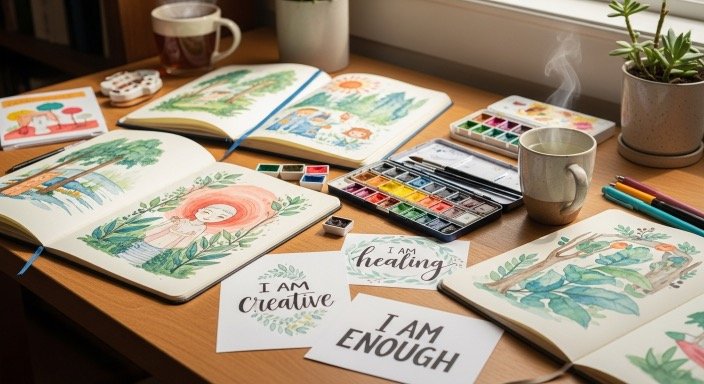
You don’t need hours or special materials. Healing through creativity thrives in small, intentional moments:
- Morning doodles: sketch whatever you feel before checking your phone.
- Affirmation cards: decorate small index cards with encouraging phrases.
- Mindful photography: capture light, texture, or shapes that evoke calm.
- DIY gratitude journal: mix paint swatches and handwritten notes of appreciation.
- Color meditation: choose one hue daily and explore its emotion.
Consistency, not perfection, is the secret.
Pair creative rituals with affirmations from Positive Affirmations for Self Love – Reprogram Your Mind— creativity amplifies each message’s impact.
12. When Creativity Feels Emotional or Overwhelming
Sometimes art opens old wounds. That’s okay — healing means feeling.
If strong emotions arise, pause. Take deep breaths, step away, or journal what surfaced. Creative healing is about pacing, not pushing.
If emotional distress persists, reaching out for professional support is wise. Therapists trained in art therapy or expressive therapies can guide you safely through this exploration.
You are not “doing it wrong” if creativity stirs tears — that’s the mind freeing itself.
13. Creativity and the Inner Child
Much of our emotional tension roots in childhood — when play was natural but expression was silenced.
Reconnecting with your inner child through creative play restores innocence and spontaneity.
Finger-painting, collage, or even building with clay awakens curiosity and joy.
This isn’t regression; it’s reconnection. Play teaches safety, and safety heals.
For visual inspiration on gentle self-rediscovery, explore 20 Affirmation Art Images That Will Encourage Daily Positivity — it embodies that playful, healing energy through design.
14. Creativity as Spiritual Healing
Beyond emotion, creativity can reconnect us to something larger — whether you call it spirituality, intuition, or simply wonder.
Many describe the act of creation as a dialogue with the soul. The more you create, the more you trust your inner voice.
Art becomes prayer; brushstrokes become breath.
This spiritual dimension of creativity aligns with practices like meditation, gratitude, and reflective journaling. It’s about being fully alive — aware, expressive, and open.
15. The Ripple Effect: How Creative Healing Spreads
Healing through creativity doesn’t stop with you. When you share art, you share permission — for others to feel, to heal, to create.
A simple painting posted online, a handmade card, or a song written in private can touch someone else’s heart quietly but profoundly.
That’s how creativity becomes a ripple of collective healing — small acts of beauty turning into waves of empathy.
Bringing It All Together: Art as Freedom
Art frees the mind by turning pain into pattern, chaos into color, silence into song.
It’s not about creating masterpieces — it’s about making space inside yourself where hope can breathe again.
Every brushstroke, every poem, every melody is a declaration:
“I am more than my pain. I am becoming through creation.”
So pick up the pen, the paintbrush, the camera, or the instrument. Let your hands do what your heart has been waiting to say.
Because in the end, art doesn’t just free the mind — it heals the soul.