
Positive words in songs and your mental health
Have you ever had a song lift you out of sadness in under a minute?
That’s not coincidence — it’s chemistry.
Music has the power to shape emotions, shift thoughts, and change how you see yourself. The words that fill your playlists don’t just sit in your ears; they echo through your nervous system, influencing mood, confidence, and mental energy.
When you listen to lyrics about love, worth, or peace, your brain releases dopamine (the “feel-good” chemical) and oxytocin (the “bonding” hormone). Together, they build emotional safety — reminding you that you’re connected, capable, and enough.
But not all songs nurture us equally. The difference between “I’m broken without you” and “I’m strong because I love myself” is not just lyrical — it’s emotional programming.
Let’s explore how positive words in songs can heal the mind, rebuild self-worth, and become part of your personal therapy toolkit.
1. Music and Mental Health — The Science of Positivity
Neuroscience has proven that music activates nearly every region of the brain. When lyrics contain positive emotional words like “love,” “hope,” “peace,” or “worthy,” they trigger areas responsible for joy, empathy, and connection.
A 2023 Frontiers in Psychology study showed that songs with uplifting or empowering lyrics can reduce anxiety symptoms and enhance self-esteem.
Listening to songs filled with encouraging words works much like affirmations — but on rhythm.
read: Positive Affirmations for Self-Love – Reprogram Your Mind — learn how daily repetition of kind words reshapes your brain’s self-perception pathways, just like the repeated lyrics of a song.
When music and language combine, your emotional response becomes amplified. That’s why positive words set to melody are often more powerful than affirmations alone — they reach both heart and memory.
2. The Healing Frequency — How Sound Shapes Emotion
Every note carries frequency, and your brain responds to those vibrations.
Lower frequencies can ground and calm you, while higher tones uplift mood and motivation. Combine that with lyrics about healing or hope, and you create a double dose of emotional restoration.
Think of a song like a guided meditation you can hum.
The repeated positive phrases — “you are loved,” “you can rise,” “you are enough” — act as mantras.
Music therapists often use “lyrical reconditioning”, a practice where individuals replace self-critical mental loops with healing lyrics they repeat or sing aloud.
Harvard Health – The Healing Power of Music notes that melody and language together can lower heart rate and increase serotonin, supporting long-term mood balance.
3. Love in Lyrics — Why the Word “Love” Lifts the Brain
The most common positive word in music history is love — and for good reason.
When you hear or sing it, your body responds as though you’re giving or receiving care. It’s not just sentiment — it’s biology.
The word love activates oxytocin release, which calms the amygdala (the brain’s fear center).
So when you sing along to “I will always love you” or “You are loved,” you’re not just expressing emotion; you’re rewiring fear into safety.
But love lyrics can also strengthen self-love, not just romantic attachment.
Choosing songs about self-worth — like Lizzo’s “Soulmate” or Demi Lovato’s “I Love Me” — reminds listeners to build internal validation.
Pair this with creative healing ideas from Healing Through Creativity: How Does Art Free the Mind — both art and music allow your emotions to express love beyond words.
4. “Peace” and “Calm” — Words That Slow Anxiety
Positive words in songs and your mental health

Positive words in songs and your mental health
If you’ve ever listened to songs that repeat “peace,” “breathe,” or “calm,” you might notice your body following the command almost instantly.
That’s not accidental. Positive lyrical cues synchronize your heart rate and respiration to the song’s rhythm.
This is why soft acoustic tracks, slow R&B, or instrumental pop with peaceful lyrics often reduce racing thoughts or panic.
Your brain starts mirroring what it hears — an effect psychologists call entrainment.
Try creating a “peace playlist” filled with songs that include words like stillness, breathe, serenity, or safe.
These phrases train your subconscious to associate music with safety, gradually lowering stress even when you’re not listening.
5. Songs About “Worth” — Healing the Inner Critic
Words like worth, strong, enough, and beautiful are the antidotes to self-doubt.
Hearing these words repeatedly through song strengthens positive self-talk networks in the brain.
When we listen to empowering anthems such as “Stronger (What Doesn’t Kill You)” by Kelly Clarkson or “Born This Way” by Lady Gaga, our nervous system responds with motivation.
These songs help us internalize resilience by associating it with rhythm and reward.
Even simple lyrical refrains like “I’m worth it” or “I can do this” reprogram limiting beliefs — the same principle used in therapeutic affirmations.
Research from the American Psychological Association confirms that repeated exposure to encouraging messages improves emotional stability and confidence over time.
6. Music as Emotional Mirror — Why We Choose What We Hear
Music reflects mood, but it can also change it.
When you’re sad, you may unconsciously seek melancholic songs that match your feelings. That’s emotional validation — your mind saying, “Yes, this is how I feel.”
The key to emotional health is to follow that validation with redirection.
After expressing through sad music, gradually transition to tracks with words of recovery — “healing,” “light,” “hope.”
This gradual shift helps your brain move from acknowledgment to resilience, much like the emotional flow described in 10 Self-Love Quotes That Will Heal Your Heart and Soothe Your Soul.
Sad songs aren’t dangerous — they’re cathartic. But healing begins when the lyrics start guiding you out of sadness, not just keeping you in it.
7. Group Singing and Connection — Words That Unite
There’s something deeply healing about singing together.
Choirs, concerts, and even karaoke sessions release dopamine and endorphins because music is a social experience.
Singing positive lyrics in a group amplifies connection — literally syncing heartbeats and breathing patterns between participants.
That’s why communities that sing together (from churches to choirs) report higher levels of belonging and lower depression scores.
Each collective voice turns into one sound of unity and healing — proof that positive words multiply power when shared.
8. Lyrics as Modern Mantras
Ancient traditions used chants to calm the mind.
Modern culture does the same through repeated hooks in songs — short, rhythmic affirmations that embed themselves in memory.
Every “You got this,” “Keep shining,” or “Let it be” you hum becomes a subconscious mantra.
When you’re stressed, your brain often replays these snippets — offering instant emotional regulation.
So next time a hopeful lyric gets stuck in your head, take it as a sign of mental self-care.
Your mind is choosing healing repetition on your behalf.
9. Creating a Mental Health Playlist
Positive words in songs and your mental health
Positive words in songs and your mental health
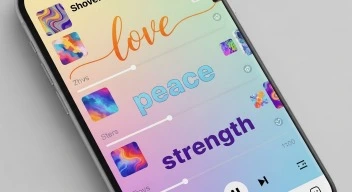
To use music intentionally for healing, build playlists around emotional intention, not just mood.
Here’s a simple structure you can follow:
| Emotion | Theme Words | Example Songs | Mental Benefit |
| Calm | Peace, breathe, stillness | “Breathe Me” – Sia, “Peaceful Easy Feeling” – Eagles | Reduces anxiety |
| Confidence | Worth, strong, power | “Fight Song” – Rachel Platten, “Confident” – Demi Lovato | Builds motivation |
| Self-Love | Love, acceptance, home | “Soulmate” – Lizzo, “Unwritten” – Natasha Bedingfield | Increases self-worth |
| Healing | Hope, rise, faith | “Rise Up” – Andra Day, “Stronger Than You Think” – Fireflight | Inspires recovery |
| Joy | Shine, smile, happy | “Happy” – Pharrell Williams | Boosts dopamine |
Play your chosen list in the morning, during journaling, or while cleaning. Over time, your brain begins to associate daily life with affirming messages — turning music into an emotional anchor.
10. Music as Gentle Therapy
You don’t need to play an instrument or sing perfectly to experience musical healing.
Simply being present with positive lyrics can regulate your nervous system, especially when combined with mindfulness or art.
Here’s a simple routine you can try tonight:
- Put on a calm song with encouraging lyrics.
- Close your eyes and notice which word stands out most — maybe “love,” “peace,” or “strong.”
- Whisper that word softly with the rhythm.
- Let your breathing follow the tempo.
- Write down how your body feels afterward.
This turns listening into active self-care — a music meditation.
Reference: Psychology Today – The Role of Music in Healing explains how musical repetition lowers cortisol and enhances emotional resilience.
Reflection — The Words You Listen to Become the Words You Believe
Every lyric you repeat teaches your mind something about you.
That’s why choosing songs filled with compassion, hope, and gratitude matters.
Music is more than background noise — it’s mental nourishment.
If you fill your world with lyrics about peace, love, and worth, you start living in those frequencies.
You begin walking differently. Speaking differently. Believing differently.
Words are powerful. But words wrapped in melody?
They become unforgettable.
The Bottom Line — Tune Your Mind to Healing
You don’t need to escape life to find peace — sometimes, you just need to change the soundtrack.
Whether it’s one uplifting chorus or an entire playlist of affirmations, the words you sing (and hear) rewrite your emotional story.
So listen with intention. Sing with heart.
And remember: every positive lyric you choose is an act of self-love — one verse closer to your healing.
Find more reflections like this in our “Healing Through Creativity” series on AllMentalIllness.com — your space for stories of hope, art, and gentle recovery.
Positive words in songs and your mental health