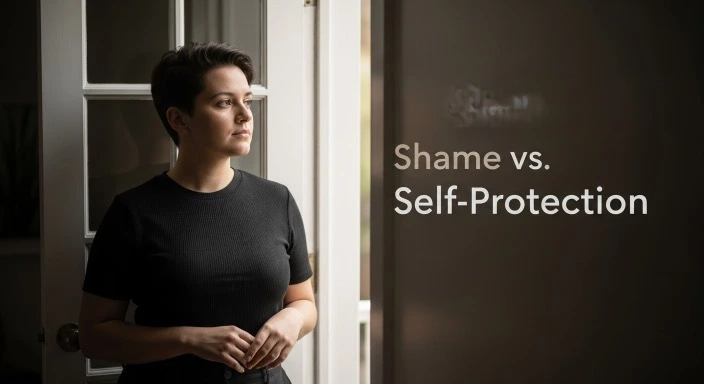
Shame vs. self-protection after trauma
After trauma, many people develop an inner voice that feels harsh, cautious, or controlling.
It might say:
- “Don’t mess this up.”
- “You should know better.”
- “Stay small so nothing bad happens.”
- “It’s safer not to try.”
From the inside, it can be confusing.
Is this self-protection — or is it shame?
This question matters more than it seems.
Because when shame is mistaken for protection, healing often stalls.
And when protection is mistaken for weakness, people push themselves before they’re ready.
This article helps you understand the difference — without judgment — so you can respond to yourself with clarity instead of criticism.
Why Shame and Self-Protection Often Feel the Same

Trauma changes how the brain evaluates risk.
After something overwhelming or unsafe, the nervous system learns:
“I need to prevent this from ever happening again.”
That learning shapes thoughts, behaviors, and emotional responses.
Both shame and self-protection can show up as:
- Avoidance
- Self-criticism
- Hypervigilance
- Emotional withdrawal
- Perfectionism
From the outside, they look identical.
From the inside, they feel similar too.
But their purpose is very different.
What Shame Actually Is (Beyond the Definition)

Shame isn’t just feeling bad about something you did.
Psychologically, shame is the belief:
“Something is wrong with me.”
It targets identity, not behavior.
Shame often sounds like:
- “I’m weak.”
- “I’m broken.”
- “I should be over this.”
- “Other people wouldn’t struggle like this.”
According to the American Psychological Association, shame is strongly linked to trauma, depression, anxiety, and lowered self-worth — especially when trauma involved blame, humiliation, or emotional invalidation.
Shame doesn’t try to keep you safe.
It tries to erase you.
What Self-Protection Really Is

Self-protection is the nervous system’s attempt to reduce danger.
It develops when:
- Boundaries were crossed
- Safety was unpredictable
- Trust was broken
- Pain felt unmanageable
Self-protection often says:
- “Slow down.”
- “Be careful.”
- “This feels like too much.”
- “I need distance right now.”
Unlike shame, protection is situational, not global.
It doesn’t say you are bad.
It says this feels unsafe.
The National Institute of Mental Health explains that trauma responses are adaptive survival strategies — even when they become limiting later.
Protection is not pathology.
It’s a response to experience.
The Key Difference: Direction of the Message
Here’s the simplest way to tell them apart.
Shame points inward.
Self-protection points outward.
Shame says:
“I am the problem.”
Protection says:
“Something here doesn’t feel safe.”
Shame attacks the self.
Protection guards the self.
That distinction matters deeply for healing.
Why Trauma Blends Shame and Protection Together
In many trauma experiences — especially relational or developmental trauma — protection required shame.
If you were told:
- You were too sensitive
- You caused the harm
- Your needs were a burden
- Speaking up made things worse
Then your system learned:
“If I criticize myself first, maybe I can avoid being hurt.”
In that context, shame became protection.
The World Health Organization recognizes that trauma recovery often involves untangling survival responses from self-concept — especially where blame and responsibility were distorted.
What once helped you survive may now be hurting you.
How Shame Masquerades as Responsibility
Many people believe shame is what keeps them accountable.
They worry:
- “If I stop being hard on myself, I’ll fall apart.”
- “If I let go of shame, I’ll become careless.”
- “I need this voice to function.”
But shame doesn’t create responsibility.
It creates fear.
True responsibility sounds calmer:
- “That didn’t work — let’s adjust.”
- “I can learn from this.”
- “I need support here.”
Shame panics.
Protection pauses.
Signs You’re Experiencing Shame (Not Protection)
You may be dealing with shame if:
- Your inner voice uses absolutes (“always,” “never”)
- You feel small, defective, or exposed
- The message attacks who you are, not what happened
- There’s pressure to hide or disappear
- Kindness toward yourself feels undeserved
Shame often escalates emotional pain rather than containing it.
Signs You’re Experiencing Self-Protection
You may be in self-protection if:
- You feel cautious but not worthless
- The response is specific to certain situations
- There’s a desire for boundaries, not punishment
- The message is about safety, not identity
- You feel relief when limits are respected
Protection can soften once safety increases.
Shame usually cannot — without intervention.
Why This Confusion Blocks Self-Compassion
When shame is mistaken for protection, self-compassion feels threatening.
Kindness can feel like:
- Letting your guard down
- Inviting danger
- Ignoring “important warnings”
This is why many trauma survivors say:
“I don’t know how to be kind to myself — it feels wrong.”
What feels wrong isn’t compassion.
It’s removing armor before safety is restored.
This is explored more deeply in our core article Why Self-Compassion Feels Hard After Trauma, which explains how safety must come before softness.
How Healing Begins: Separating the Two Gently

You don’t need to eliminate shame overnight.
Healing often starts with curiosity, not correction.
You might ask:
- “Is this voice trying to protect me — or punish me?”
- “What is it afraid would happen if it softened?”
- “Does this message help me feel safer or smaller?”
Even noticing the difference is progress.
Many people first learn this distinction in therapy, where a safe relationship allows protection to relax without shame taking over. If therapy feels intimidating, our pillar article Therapy Myths That Keep People from Getting Help may help clarify common fears.
Who This Article Is For
This article may help if you:
- Feel harsh toward yourself but don’t know why
- Confuse self-criticism with self-control
- Struggle with shame after trauma
- Want clarity without pressure to “be positive”
Who This Article Is Not For
This article is not a replacement for professional care if you:
- Are in acute emotional distress
- Experience overwhelming shame or self-harm urges
- Feel unsafe with your thoughts or behaviors
In those cases, trauma-informed support is essential.
Short FAQ
Can shame ever be helpful?
Shame may signal social awareness, but chronic shame is linked to poorer mental health outcomes and rarely supports healing.
Is self-protection the same as avoidance?
Not always. Protection seeks safety; avoidance seeks escape. The difference is intention and impact.
Why does shame feel so convincing?
Because it often formed in environments where self-blame reduced harm or conflict.
Can self-protection soften over time?
Yes — when safety, boundaries, and support increase, protection no longer needs to be rigid.
Final Thoughts
You learned to survive in a specific context.
Some of what you learned was protective.
Some of it was painful.
Healing doesn’t mean tearing those strategies away.
It means updating them with compassion and clarity.
You are allowed to protect yourself without shaming yourself.
Those two were never meant to be the same.
Find stories of healing, hope, and growth at AllMentalIllness.com — your space for better mental health.
Our Authority Sources
- American Psychological Association
Research on shame, trauma, and self-concept highlights how internalized blame affects emotional health and recovery. - National Institute of Mental Health
Evidence-based information on trauma responses, emotional regulation, and adaptive coping strategies. - World Health Organization
Guidance on trauma-informed mental health care and the importance of safety and non-stigmatizing support.