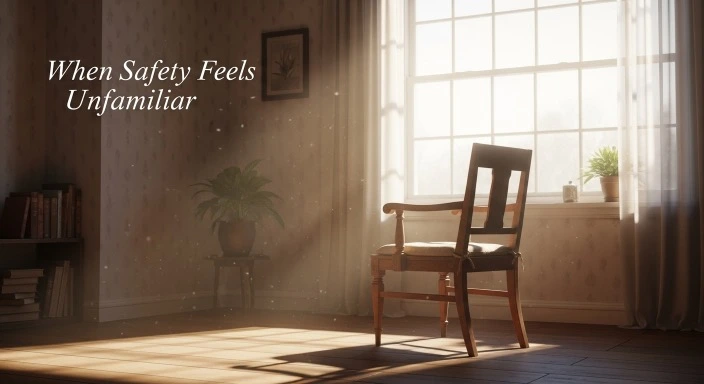
When safety feels unfamiliar
There’s a moment that surprises many people during healing.
Nothing is wrong.
Nothing bad is happening.
No one is demanding anything from you.
And yet—you feel uneasy.
Your body stays alert.
Your thoughts scan for problems.
Rest feels suspicious instead of soothing.
If this sounds familiar, you’re not broken.
You’re not “regressing.”
And you’re not failing at healing.
This article exists to explain why safety can feel unfamiliar after long periods of emotional strain, trauma, or survival mode—and how to work with that experience instead of fighting it.
The One Emotional Question This Article Answers
Why does safety feel uncomfortable or unsettling after trauma, burnout, or long-term self-protection—and what can you do when calm doesn’t feel calm yet?
This is not an article about forcing relaxation or becoming fearless overnight.
It’s about normalizing a very real phase of recovery that often goes unnamed.
Why Safety Can Feel Wrong at First

When you’ve lived in survival mode for a long time, your nervous system adapts.
It learns:
- how to stay alert
- how to anticipate danger
- how to function under pressure
- how to stay “ready”
Those adaptations kept you going.
So when safety finally appears—quiet, unstructured, undemanding—your system doesn’t automatically recognize it as good.
Instead, it asks:
What am I missing?
This isn’t anxiety coming from nowhere.
It’s conditioning.
According to the American Psychological Association, prolonged stress reshapes how the nervous system responds to both threat and calm, making safety feel unfamiliar at first.
Survival Mode Trains the Body, Not Just the Mind
Healing isn’t only a mindset shift.
Safety is somatic—it lives in the body.
If your system learned that:
- calm meant something bad was coming
- rest meant vulnerability
- stillness meant danger
Then safety won’t feel soothing right away.
It will feel foreign.
This is why insight alone isn’t enough. Your body needs time and repetition to update what “safe” means.
Common Signs That Safety Feels Unfamiliar
You might notice:
- restlessness during quiet moments
- discomfort when nothing is “wrong”
- urge to stay busy or distracted
- emotional flatness instead of relief
- guilt when resting
- fear that calm won’t last
These are not signs you’re unsafe.
They’re signs your nervous system hasn’t recalibrated yet.
If this connects to trauma recovery, this companion piece may help deepen context:
Why Self-Compassion Feels Hard After Trauma (Build Self-Love)
Why “Just Relax” Doesn’t Work

Telling yourself to relax often backfires.
Why?
Because your nervous system doesn’t respond to logic.
It responds to experience.
Relaxation becomes possible only after repeated signals of:
- predictability
- choice
- agency
- gentleness
Pressure to relax creates more tension—not safety.
This is why healing can feel slower than expected, even when life is calmer on the surface.
Safety After Survival Often Feels Like Emptiness
This part is rarely talked about.
After long-term survival, safety can feel:
- quiet
- flat
- emotionally neutral
- underwhelming
People sometimes think:
- “Something is missing.”
- “I should feel happier.”
- “Why don’t I feel relief?”
But safety is not euphoria.
It’s the absence of threat—and absence can feel strange when you’re used to intensity.
A Few Words for This Moment
Nothing is asking from you right now.
No role needs to be played.
Your body is learning a new rhythm—
one without urgency.
Why Safety Can Trigger Old Patterns
Ironically, safety can activate old habits:
- overthinking
- people-pleasing
- self-criticism
- over-functioning
Why?
Because those patterns once created structure inside chaos.
If you were “the strong one,” calm may feel like loss of identity.
This distinction is explored further in:
Shame vs. Self-Protection: How to Tell the Difference After Trauma
Safety Is Learned Through Repetition, Not Insight
You don’t think your way into safety.
You experience it—slowly.
Helpful signals include:
- keeping small promises to yourself
- predictable routines
- saying no without punishment
- resting without justification
- leaving draining environments
Each moment teaches your system:
This is survivable.
Why Self-Love Feels Different When Safety Is New
When safety is unfamiliar, even self-care can feel awkward.
Kind words may feel:
- undeserved
- exaggerated
- untrue
That doesn’t mean they’re wrong.
It means your system isn’t used to them yet.
This article pairs naturally here:
Self-Love Quotes for Healing from Trauma (Words That Truly Help)
Self-love works best when it supports safety, not when it demands belief.
The Role of Boundaries in Relearning Safety

Boundaries create predictability.
When you:
- limit emotional exposure
- protect your energy
- pause before overwhelm
Your nervous system learns it doesn’t have to stay hyper-alert.
Boundaries aren’t walls.
They’re signals of safety.
If therapy feels like a next step but brings hesitation, this pillar article may help:
Therapy Myths That Keep People from Getting Help
Safety vs. Comfort (An Important Distinction)
Safety doesn’t always feel comfortable.
Comfort is familiar.
Safety is regulated.
Early on, comfort may look like:
- staying busy
- staying needed
- staying tense
Safety looks quieter—and therefore strange.
This distinction matters when judging your progress.
When Safety Feels Boring (and Why That’s Okay)
Another unexpected experience: boredom.
After chaos, calm can feel dull.
That doesn’t mean life is empty.
It means your system isn’t flooded anymore.
Verywell Mind notes that emotional regulation often feels neutral before it feels good.
Neutral is not failure.
It’s baseline.
Who This Article Is For
This article is for you if:
- calm feels uncomfortable
- rest makes you uneasy
- healing feels quieter than expected
- you’re not in crisis, but not relaxed either
- you’re learning how to feel safe again
Who This Article Is Not For
This article may not be enough if:
- you are in immediate danger or crisis
- you need urgent clinical intervention
- you are seeking quick emotional highs
Different moments require different kinds of support.
Common Questions People Ask
Why do I feel anxious when things are finally okay?
Because your nervous system hasn’t updated its expectations yet.
Will safety ever feel normal?
For most people, yes—gradually and through repetition.
Does this mean I’m not healing?
No. This phase often appears because healing has begun.
Short FAQ
Is it normal to miss intensity?
Yes. Intensity once signaled control or aliveness.
Should I push myself to relax more?
No. Safety grows through permission, not force.
How long does this phase last?
It varies. Patience matters more than timelines.
The Bottom Line

If safety feels unfamiliar, let this reassure you:
Nothing is wrong with you.
Your system is adjusting.
You spent time learning how to survive.
Now you’re learning how to rest.
That learning takes time.
You don’t need to rush calm.
You don’t need to prove healing.
Safety becomes familiar
moment by moment.
Find stories of healing, hope, and growth at AllMentalIllness.com — your space for better mental health.
Our Authority Sources
- American Psychological Association (APA)
Research on prolonged stress and nervous-system adaptation explains why calm can feel unfamiliar after survival mode. - National Institute of Mental Health (NIMH)
Evidence-based guidance on trauma, stress responses, and emotional regulation. - Verywell Mind
Educational resources on emotional regulation and mental health recovery patterns.